Improving discoverability and usability for a Teams feature used by 100M+ users

Microsoft Teams feature improvement overview
100M+
Active users the improvement can reach
90%+
Active users have the potential of adopting the improved feature
mild to wild exploration
Microsoft Teams Metro Introduction
My Role
Product Design Intern
Duration
June 2026 – Sep 2026
Skills Applied
AI-infused product design
Hi-fidelity prototyping
Cross-functional collaboration
Usability research

This work is under NDA

For more details, please email me or DM me on LinkedIn.

Summary

Improved a Teams feature and delivered a development-ready design, alongside a 3-step AI-infused future roadmap for 100M+ active users.

Teams comment resolution summary

As the only design intern on the Teams design team, I worked closely with PM, research, and design leaders to reimagine the experience of an organization feature in Teams.

I led early problem space exploration, design exploration, high-fidelity prototyping, and usability testing, translating data into design opportunities and eventually design solutions, including a readily shippable solution and a 3-step AI-infused future design roadmap.

I designed high-fidelity prototypes within Teams' enterprise design system, using AI tools to accelerate prototyping and refine detail, and built 4 prototype variants for an A/B study run in collaboration with a researcher.

Beyond discoverability, I also improved usability within the existing flow: I added a bulk selection capability so users could act on multiple items at once instead of one at a time, which had been slowing people down.

Delivered a mild-to-wild solution set
Explored solutions from quick feature improvement to bold, future-facing AI-infused concepts to shape the shippable design and future roadmap.
Designed an interactive high-fidelity prototype
Utilizing Teams and the Fluent design system, I built an interactive prototype and leveraged AI tools to accelerate the prototyping process.
Ran a usability study
Recruited and moderated 6 participants, synthesized findings into a report, and paired telemetry data with qualitative insights to inform design iterations.

Impact

Delivered a shippable solution and a longer-term AI-infused vision

The improved feature...

Scales better
Reduces search and navigation effort
Reduces context switching
Reflection

1. Pain points take digging

The real gaps weren't obvious from the surface. I had to dig into telemetry and user insights to spot the discrepancies worth designing for, and since the people who held that context were often busy, I had to be strategic about when to ask for it and proactive about unblocking myself when I couldn't get an answer right away.

2. Explore a lot!

I learned to generate a wide range of options before narrowing in, asking for feedback early and often. Exploring different tools to visualize the interaction process helped me communicate ideas faster and get sharper feedback sooner.

3. AI changes the pace, not the judgment

AI tools sped up prototyping and detail work, but the harder calls, like what to test and why, still came down to design judgment and research.

4. Immediate and long-term aren't in conflict

Delivering a dev-ready solution alongside a 3-step roadmap meant I had to think in two timelines at once, without letting either one slow the other down.

Thank you!

Grateful to the Teams design team for a fruitful summer and the space to grow as a designer.

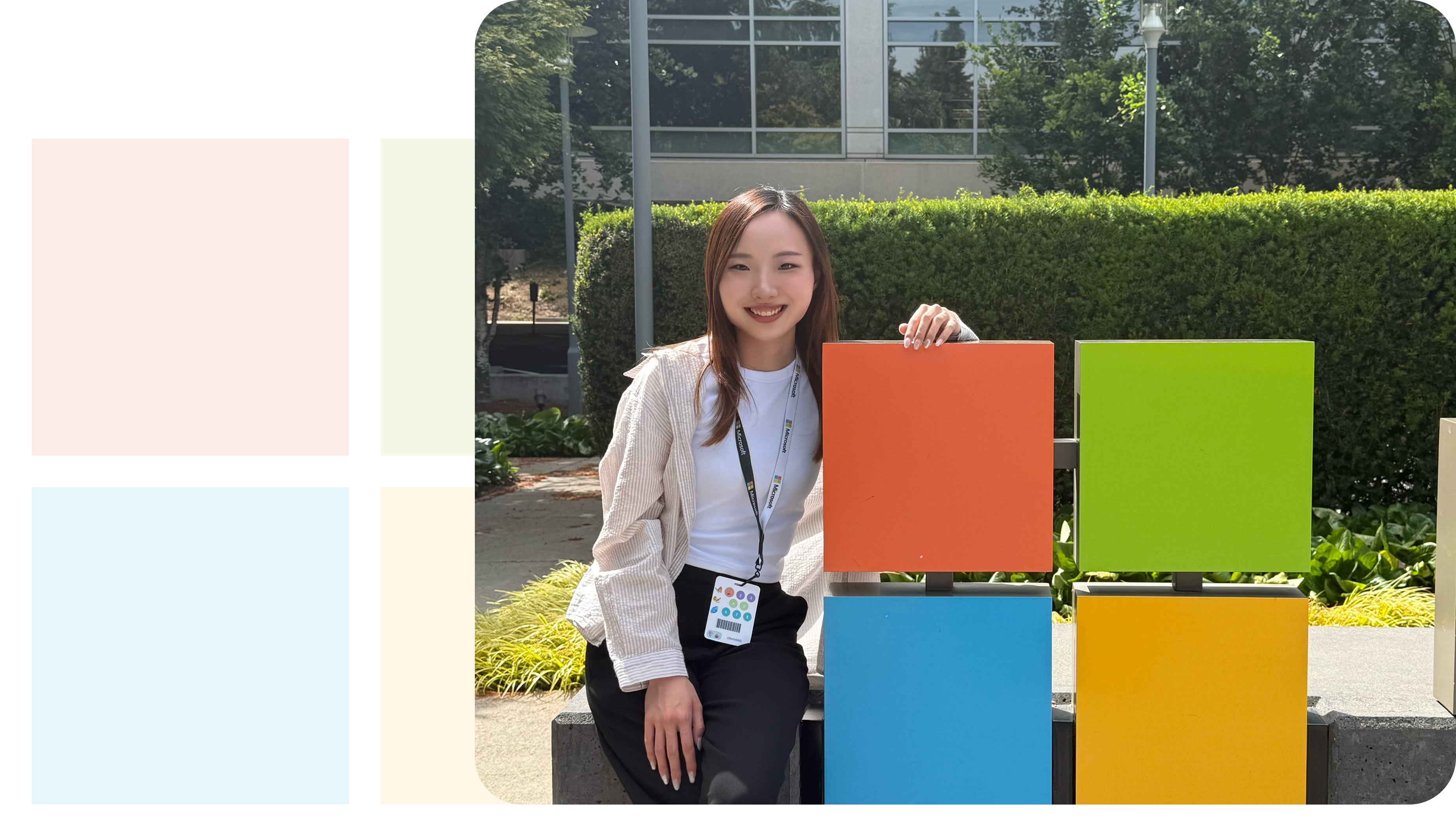
Lina at Microsoft with the Microsoft logo blocks

Next Project

See my Agnes AI design work